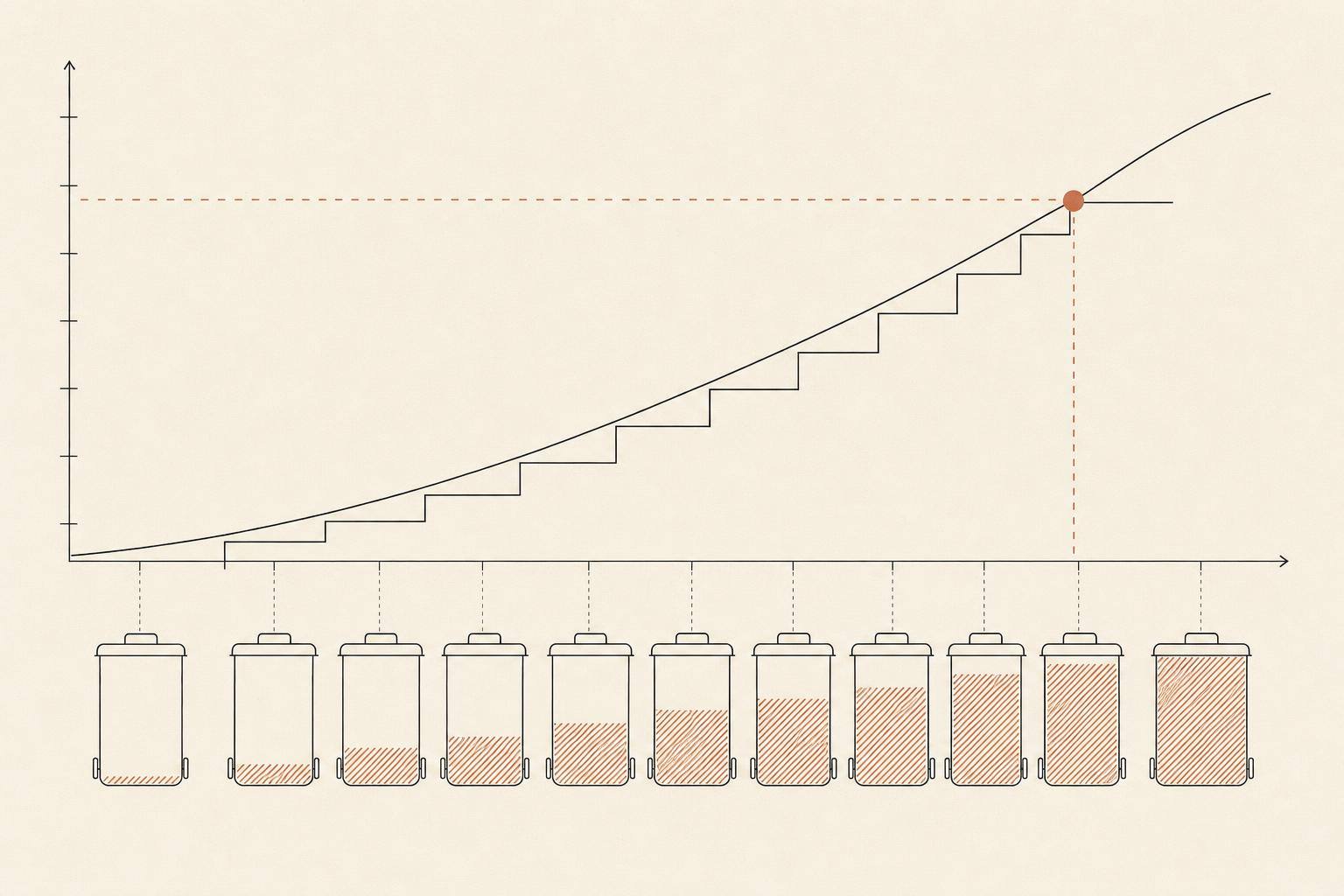
KOCO Solutions sells software for waste collection, and their existing forecast was an adaptive linear regression: average the fill rate between two collections and extrapolate. It works, but it only ever sees data from collection days, which is a handful of points a week.
The first problem wasn't modelling, it was shape. Weights recorded at collection points had to become a continuous series before any time-series model could touch them, so we converted the measurements into a chain of linear regressions and interpolated between them to get a fill rate in kg/day. We started at kg/hour, and abandoned it: only 2.15% of those points were real measurements against 25.6% at daily resolution, and there was no field evidence that filling is linear within a day. Choosing the coarser resolution was the decision that made the numbers trustworthy.
Then we put five model families against the incumbent: Prophet, FFT, RNN, LSTM and Transformers. Every model faced the same two-way protocol: one score on every interpolated point, one on real collection days only. The first measures whether the curve is right, the second whether it is useful on the day a dispatcher makes a decision.
The deep models lost. RNNs, LSTMs and Transformers landed at or slightly below KOCO's linear baseline while costing the same to train and run. Prophet and FFT won, and Prophet won clearly: 48.04 kg mean absolute error against the incumbent's 75.0 kg, and 19.80% MAPE against 40.42%. The remaining recommendations came out of exploratory analysis, not taste: outliers were doing real damage, so a log transform and splitting containers by size went in.
It shipped as something they can run without us: a dockerised train-and-infer pipeline configured by TOML, plus a modular analysis toolkit for seasonality, measurement intervals and trends per waste type. We also answered the operational questions a rollout decision hangs on. Roughly four months of history at one to three measurements a week is enough to train, and for a new container at an existing site, a model from a same-type neighbour lands within ±5%.
Both partners rated the project 1 of 4, very successful, in the final report to Innosuisse.